CloudNC Autodesk Strategic Update
and Competitor Analysis

We did this with access to only 9% of the addressable market via Fusion and Mastercam, with four sales heads and three marketing heads. We are not aware of another industrial software startup that has achieved this growth pace or efficiency. This is top 3% SaaS growth speed in a vertical that typically grows below median.
The market is desperate for a CAM automation solution. The US now needs two machinists for every one it has, with a 10% per year retirement rate at the same time as a defense ramp and multi-trillion-dollar reshoring efforts are causing a demand crunch. This is the perfect time to expand, scale, and consolidate the CAM market.
1. Competitor Traction
| Company | ARR | Growth | Notes |
|---|---|---|---|
| CloudNC | $6.3M | 5.5x | 85% inbound · 5-day sales cycle · 1:1 GTM efficiency |
| Lambda Function | Pre-PMF | Minimal | Not scaling. Supervised ML approach. |
| Toolpath | Pre-PMF | Minimal | Game-playing AI approach. Co-founder and CTO departed March 2026. Quoting focus. 3-axis ceiling. |
| LimitlessCNC | Pre-PMF | Minimal | 3-6 month on-site deployments. High-volume production only. |
| up2parts | Pre-PMF | n/a | Sandvik-backed. No meaningful traction. |
| Manukai | Pre-PMF | n/a | Siemens Xcelerator-backed. No meaningful traction. |
2. The Technical Divide
There are two fundamentally different approaches to AI-assisted CAM. The divide is architectural, not incremental, and it determines what is possible.
| Physics-Based AI CloudNC |
Supervised ML LimitlessCNC · Lambda · up2parts · Manukai |
Game-Playing AI Toolpath |
Legacy Rule-Based FeatureCAM era |
|---|---|---|---|
| Generates novel strategies from first principles | Replays patterns from training data; must be trained on every factory setup | Game-tree search applied to machining strategy | If-then templates from expert knowledge |
| Handles any geometry without retraining | Fails on unseen geometry classes | Limited capability | Rigid; breaks in most cases. Non-portable |
| Fully cloud-native, processes in seconds | Heavy compute; long processing times | Narrow domain; single-part focus | Desktop-bound, no cloud architecture |
| Agentic workflows: quoting, DFM, full CAM | N/A | N/A | N/A |
Why Physics-Based AI, Not Machine Learning
The CNC machining problem has a fundamental property that makes it unsuitable for neural network approaches: the search space is vast, the precision required is extreme, and the training data does not exist at scale. A supervised learning model trained on a factory's historical programs will reproduce what that factory's machinists already do, on parts similar to what they have already made, with the tooling they already own. It does not generalise. Moving to a new facility, a new material, or an unfamiliar geometry class requires retraining. This imposes a hard ceiling on both capability and scalability.
CloudNC takes a fundamentally different approach. We have built primitives that accurately model the physics of the machining process and search through the space of possible strategies at extremely high speed, resolved using classical AI optimisers. This is closer in architecture to AlphaGo than to ChatGPT: a fast, accurate simulator combined with intelligent search, not pattern-matching on historical data. The result is a system that generalises across geometries, materials, toolsets, and machine configurations without retraining. It works on day one in any factory.
Furthermore, CloudNC's primitives can be driven using an LLM, resulting in a combined capability that is greater than either approach alone.
This distinction is the reason CloudNC scales and competitors do not. ML-based approaches are fundamentally limited: they cannot generalise without per-facility retraining, which caps both their market reach and their capability ceiling.
The Investment Gap
CloudNC has invested 10 years and $70M+ building its physics-based CAM kernel. The primitives we have built cannot be vibe-coded. They depend on extensive data collected over seven years in our own factory with significant machine instrumentation, combined with novel computer science and physics models. It is 11 AI primitives spanning feature recognition, strategy solving, collision avoidance, toolpath optimization and more, purpose-built from the ground up for AI and autonomous operation.
3. Platform Requirements
Fusion is a cloud-native platform serving hundreds of thousands of users making everything from prototypes to production parts. Any AI CAM solution must meet these requirements to function at platform scale.
| Requirement | CloudNC | LimitlessCNC | Lambda | Toolpath | Manukai |
|---|---|---|---|---|---|
| Cloud-native architecture | ✓ | ✗ | ✗ | ✓ | ✗ |
| 3+2 axis strategy generation | ✓ | ✓ | ✗ | ✗ | ✗ |
| Independent of ModuleWorks/Siemens kernel | ✓ | ✗ | ✗ | ✗ | ✗ |
| Generalisable across geometries | ✓ | ✗ | ✗ | ✓ | ✗ |
| Post-product-market-fit | ✓ | ✗ | ✗ | ✗ | ✗ |
| Agentic workflow capability | ✓ | ✗ | ✗ | ✗ | ✗ |
We are not aware of any competitive efforts to build a new, AI-native CAM kernel. CloudNC is the only company that meets all six requirements.
4. Scaling Trajectory
Three independent growth levers, each compounding on the others.
Integration Expansion
2 of 30+ CAM package integrations are live today (Fusion and Mastercam). 4 more are in beta (Siemens NX, GibbsCAM, SolidCAM, PTC Creo). GibbsCAM alone added $50K in ARR this month. Each integration opens a new addressable base of machinists who can adopt without switching CAM software.
The CAM market has 2.4 million installed seats. Each integration mechanically increases our addressable surface and therefore our growth rate:
| Phase | Integrations | Est. Seats Covered | % of Market |
|---|---|---|---|
| Today (2 live) | Fusion, Mastercam | ~209K | 9% |
| H1 2026 (+6 beta/shipping) | + NX, GibbsCAM (beta), SolidCAM, Creo | ~456K | 19% |
| H2 2026 (+5 more) | + ESPRIT, EDGECAM, TopSolid, CimatronE, BobCAD-CAM, + others | ~706K | 29% |
Seat estimates based on CIMdata, vendor disclosures, and industry surveys.
Usage-Based Expansion
Usage-based billing activates mid-2026. Customers land at ~60 credits/mo/user. By month 24, mature customers use 520 credits/mo across 4 users. 100 credits/mo are included in the base subscription; everything above is expansion revenue at zero incremental acquisition cost.
This is the same consumption-based model that is driving agentic businesses to massive growth. The difference: CloudNC's consumption is tied to physical production. Every part that gets programmed generates usage. As factories automate more of their workflow through CloudNC, consumption scales with their output.
Sales Team + Enterprise Motion
S&M team is planned to scale from 9 to 21 by end of 2026, adding SDRs and capacity-driven AEs. An enterprise motion is planned for April 2027 targeting $200K+ deals.
Growth Forecast
| 2025 (actual) | 2026 | 2027 | 2028 | |
|---|---|---|---|---|
| Closing ARR | $5.4M | $11.1M | $67.6M | $265.7M |
| Customers | 920 | ~1,800 | ~4,100 | ~9,800 |
| LTV:CAC (land) | 3.9x | 6.4x | 8.2x | 8.0x |
| S&M Headcount | 9 | 21 | 43 | 70 |
5. What CloudNC Is Becoming
Agentic AI is bringing down the traditional moats in manufacturing software. The barriers that have existed for decades (the difficulty of moving data out of systems, the cost of retraining people, the difficulty of building and implementing software in manufacturing, the difficulty of capturing tribal knowledge) are disappearing. Whoever comes to market first with agentic solutions is likely to shuffle the entire manufacturing software landscape permanently, in a window that will last about three to four years.
We recognised this some time ago and have functioning prototypes for agentic quoting, agentic DFM, and agentic CAM. Agentic quoting and DFM do not require a CAM package integration. Agentic CAM will soon not require one either.
Taken together, these capabilities give CloudNC an agentic answer for the entire workflow through a precision factory. The trajectory is to become the platform through which precision manufacturing happens globally.
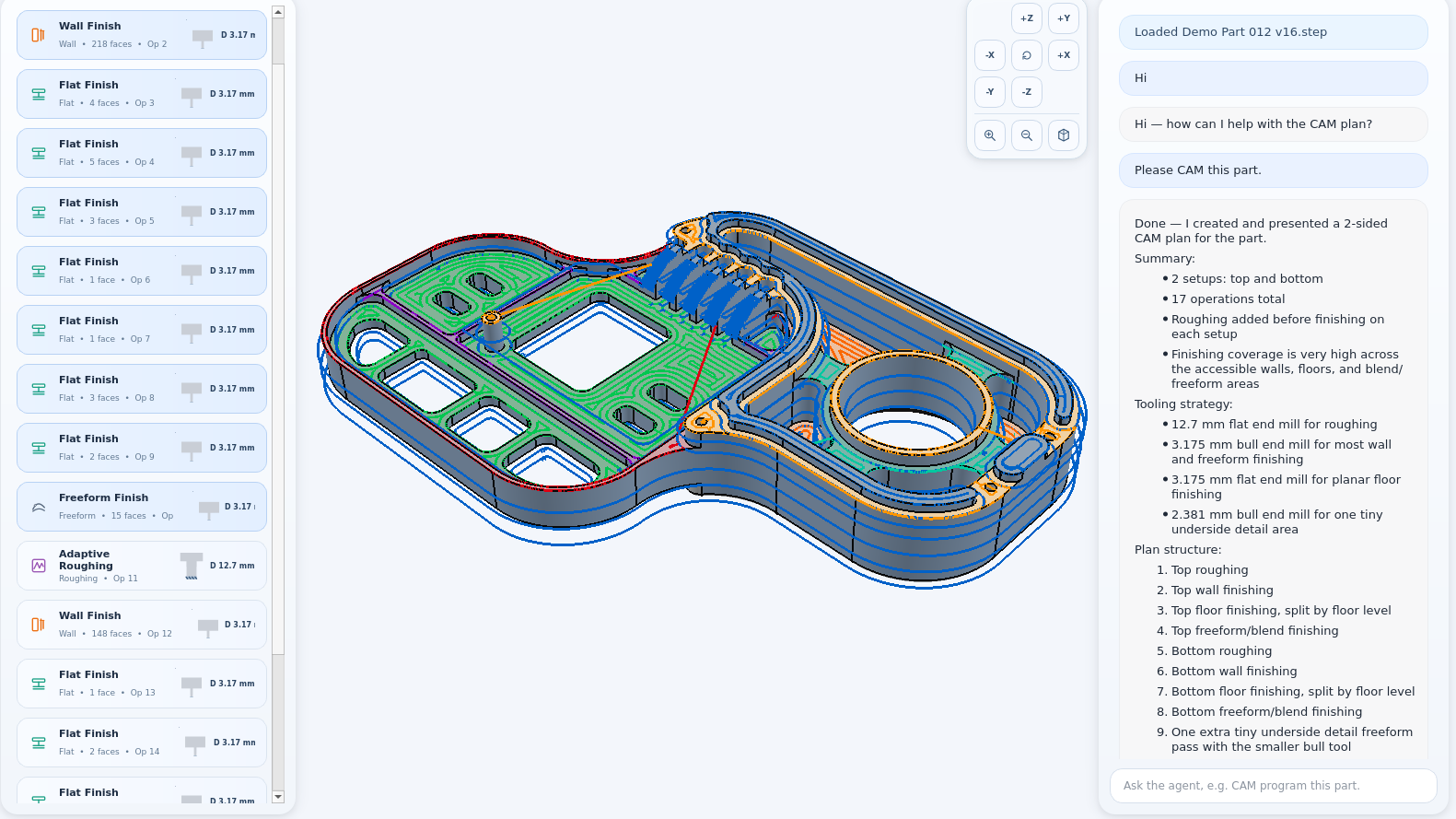
Agentic CAM
Massive steps up in capability and text-based interfaces and editability for production-grade toolpaths.
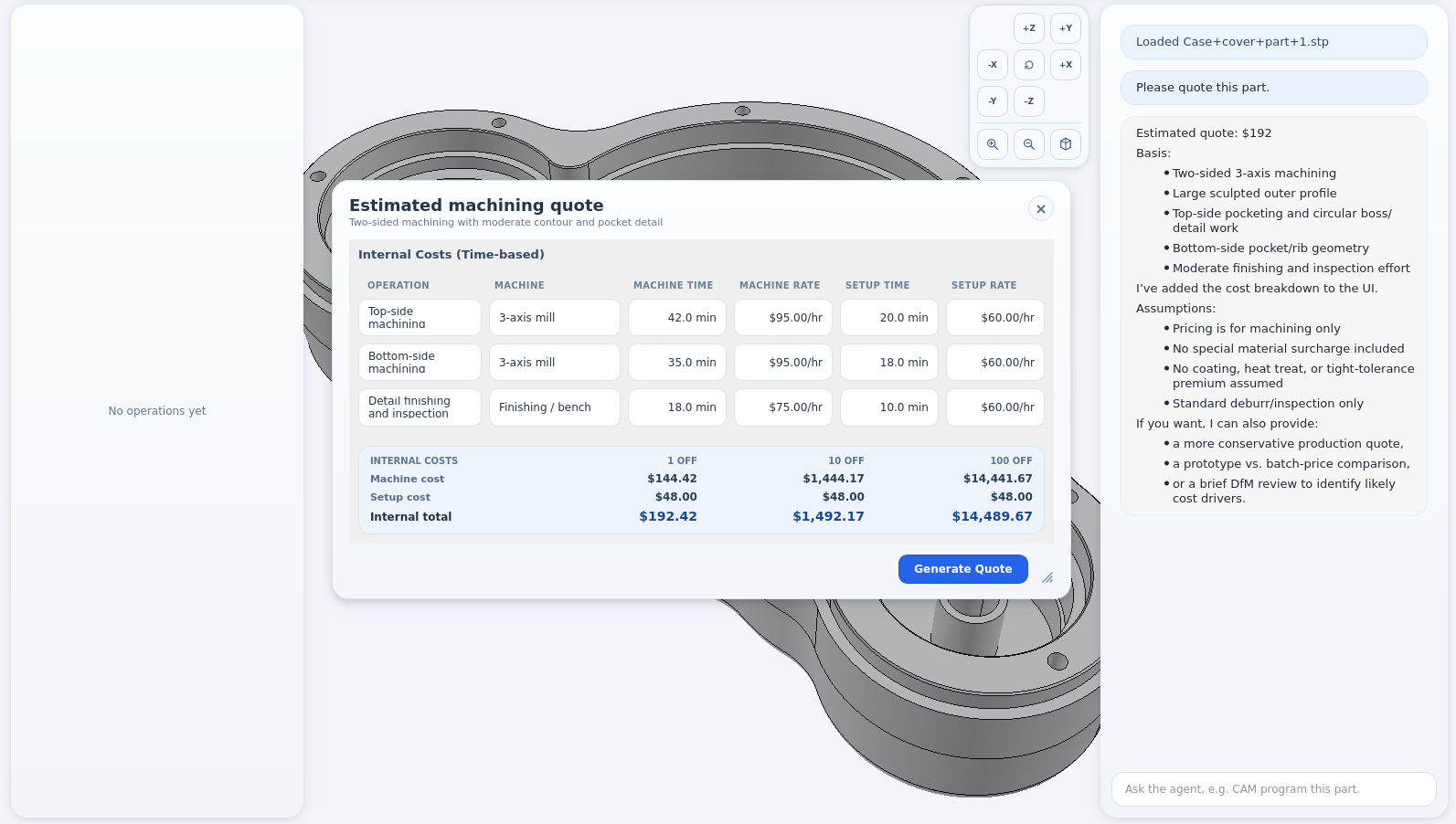
Agentic Quoting
AI-generated CNC quotes from 3D geometry. Cycle times, costs, feasibility.
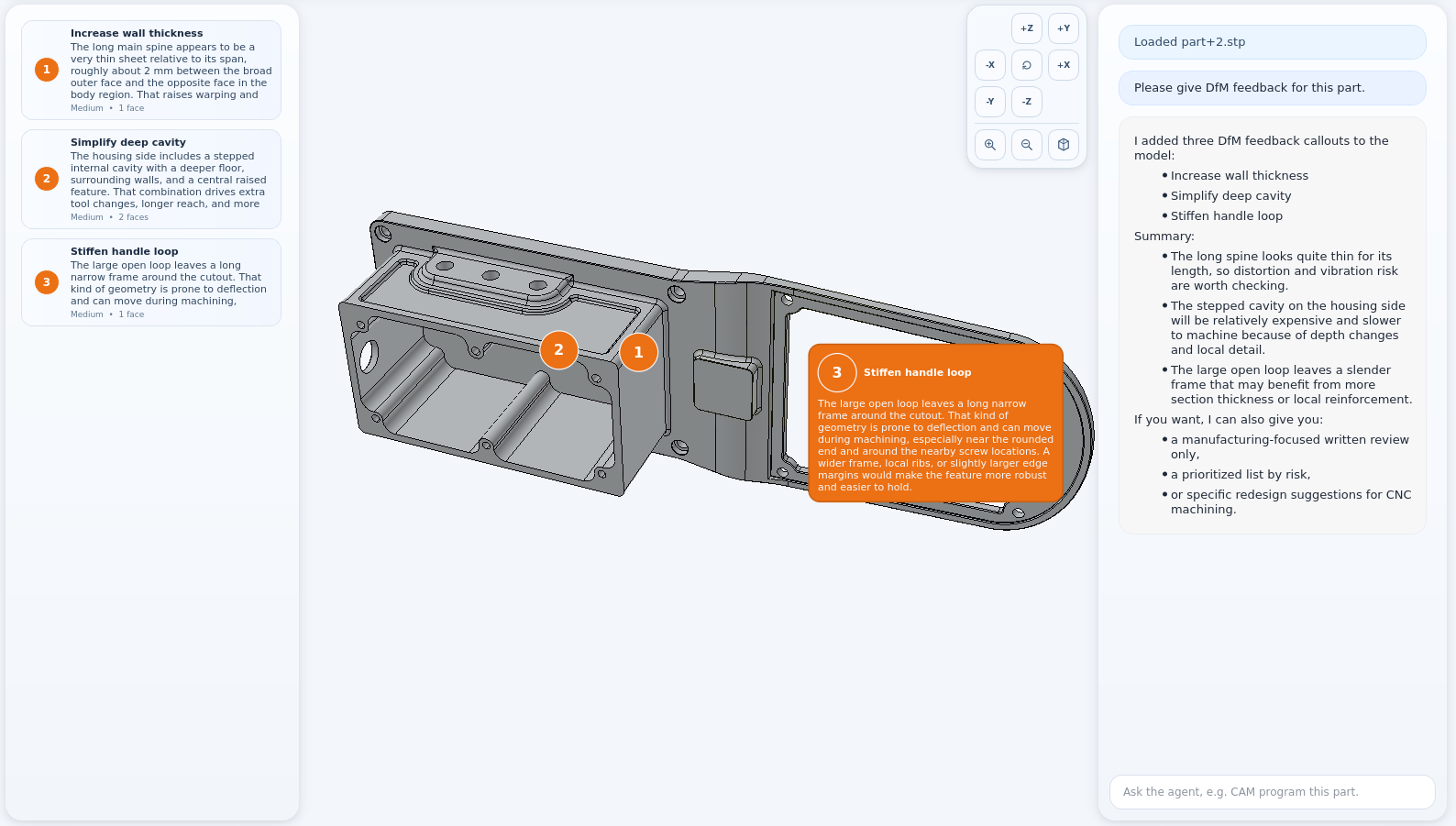
Agentic DFM
Design-for-manufacturability feedback before the part reaches the shop floor.